Fire Safety Qualifications UK: A Complete Guide to Professional Qualifications
Fire safety is an essential part of protecting people, buildings, businesses and communities across the UK. As buildings become more complex and organisations face increasing responsibilities for fire prevention, risk assessment and safety management, professional knowledge in fire safety has become increasingly important.
For individuals considering a career in fire safety, construction, facilities management, building safety, health and safety or fire risk assessment, choosing the right qualification can be challenging. The UK has a wide range of fire safety courses, certificates, diplomas, specialist qualifications and professional development programmes, each designed for different responsibilities and career stages.
What Are Fire Safety Qualifications UK?
Fire safety qualifications are structured programmes of learning and assessment designed to develop knowledge, understanding and professional capability in areas related to fire prevention, fire protection, fire risk management and building safety.
Depending on the qualification, learners may study subjects such as:
- Fire science and fire behaviour
- Fire prevention
- Fire risk assessment
- Fire safety legislation
- Emergency planning
- Means of escape
- Fire detection and alarm systems
- Fire protection systems
- Passive fire protection
- Fire doors and fire stopping
- Fire engineering principles
- Building fire safety
- Fire safety management
- Risk management
- Inspection and compliance
- Fire safety design
- Professional practice
The depth and purpose of a qualification depend on its level, awarding organisation, assessment method and specialist subject area.
This means that a short fire awareness course and a professional diploma in fire risk assessment should not be treated as equivalent qualifications. They may serve different purposes and support different responsibilities.
Why Are Fire Safety Qualifications Important in the UK?
Fire safety is not simply a matter of installing alarms and extinguishers. Effective fire safety involves identifying hazards, assessing risk, implementing appropriate controls, maintaining protection systems and ensuring people understand emergency arrangements.
In England and Wales, the Regulatory Reform (Fire Safety) Order 2005 is the principal legislation governing fire safety in non-domestic premises. It places responsibilities on the “Responsible Person”, who may include an employer, owner, landlord, occupier or another person with control of the premises.
The Responsible Person must carry out and regularly review a fire risk assessment and implement appropriate fire safety measures. Government guidance identifies key elements including identifying fire hazards, identifying people at risk, evaluating and controlling risks, recording findings, preparing emergency arrangements and reviewing the assessment.
The UK’s fire safety framework has also developed significantly in recent years. The Fire Safety Act 2021 clarified that, in relevant multi-occupied residential buildings, the structure, external walls and individual flat entrance doors fall within the scope of the Fire Safety Order for the purposes of fire risk assessment.
Changes introduced through the Building Safety Act 2022 have also strengthened responsibilities relating to fire safety information, cooperation and coordination between responsible persons and the recording of fire safety arrangements.
As a result, organisations increasingly need people who understand how fire safety requirements translate into practical risk management.
Is Fire Safety Training the Same as a Fire Safety Qualification?
Not necessarily.
One of the most important things to understand when researching fire safety education is the difference between training, CPD and a formal qualification.
Fire Safety Awareness Training
Awareness training generally introduces the fundamental principles of fire safety.
Topics may include:
- Common causes of fire
- Fire prevention
- Emergency procedures
- Evacuation
- Fire alarm awareness
- Fire extinguisher awareness
- Workplace responsibilities
For example, IOSH’s Fire Safety Awareness course is a four-hour course designed to provide a foundation for developing workplace fire safety awareness.
This type of training can be useful for employees and others who need to understand their workplace fire safety responsibilities.
Fire Marshal or Fire Warden Training
Fire marshal and fire warden training is generally more role-specific.
It can cover:
- Fire prevention checks
- Evacuation procedures
- Assembly arrangements
- Emergency communication
- Fire safety inspections
- Responsibilities during an emergency
- Awareness of firefighting equipment
This type of training is particularly relevant where an organisation has designated personnel with fire emergency responsibilities.
Professional Fire Safety Qualifications
Professional qualifications normally involve a broader and deeper programme of learning and assessment.
Depending on the qualification, learners may develop knowledge in:
- Fire legislation
- Fire risk assessment
- Fire safety management
- Fire protection
- Building safety
- Fire engineering
- Passive fire protection
- Professional reporting
- Risk evaluation
- Compliance
The appropriate route therefore depends on the learner’s existing experience, professional responsibilities and intended area of practice.
| Type | Typical purpose | Depth | Suitable for |
|---|---|---|---|
| Fire Safety Awareness | Basic understanding | Introductory | Employees and workplace personnel |
| Fire Marshal/Warden Training | Emergency responsibilities | Basic–intermediate | Designated fire wardens |
| CPD Training | Develop specific knowledge | Varies | Existing professionals |
| Professional Qualification | Structured professional learning | Intermediate–advanced | Fire safety and related professionals |
| Specialist Diploma | Develop specialist knowledge | Advanced | Professionals with relevant responsibilities |
What Types of Fire Safety Qualifications Are Available in the UK?
There is no single qualification that covers every aspect of fire safety.
The UK fire safety sector contains several specialist areas, and different qualifications are designed around those areas.
The main categories include:
- Fire safety awareness
- Fire marshal and fire warden training
- Fire risk assessment
- Fire safety management
- Fire engineering
- Passive fire protection
- Fire safety inspection
- Building safety and advanced fire safety design
- Fire service and operational qualifications
- Specialist fire protection training
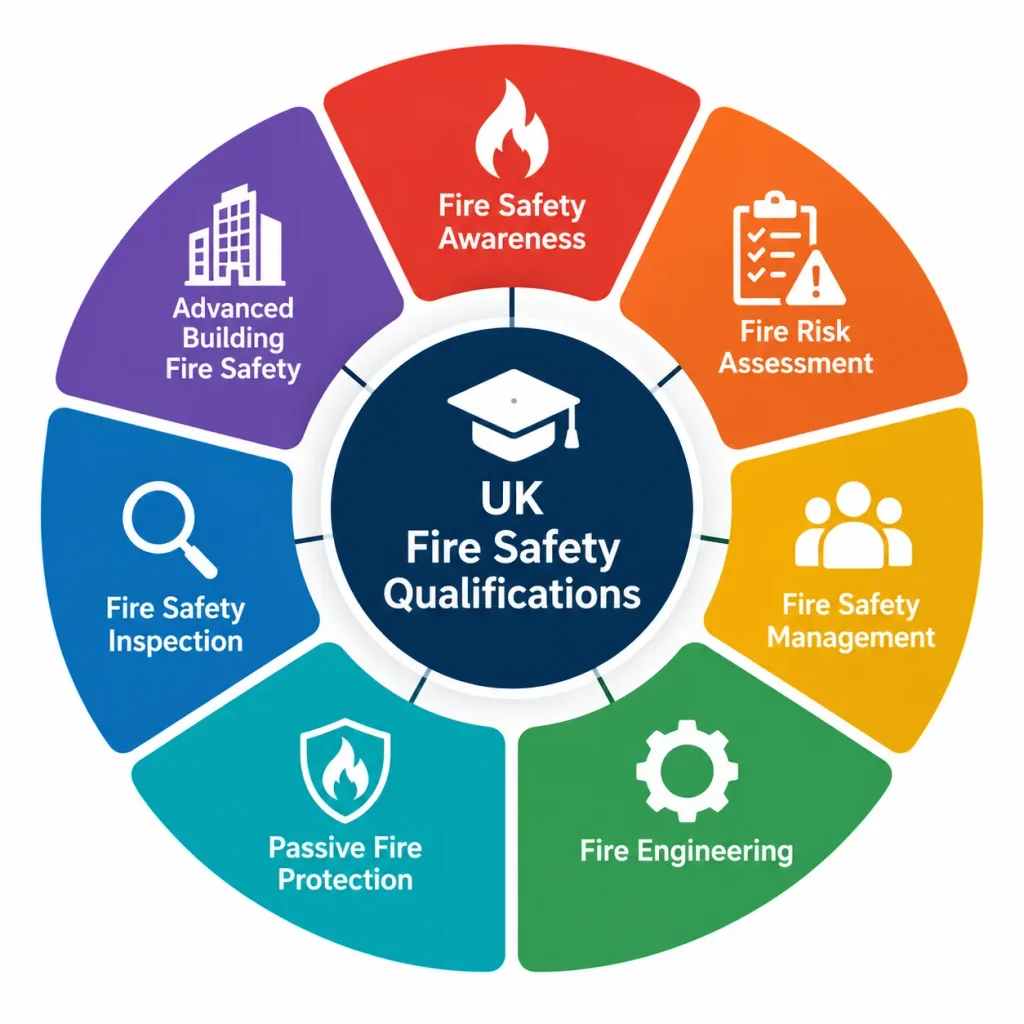
Professional organisations also offer qualifications covering specialist areas. For example, the Institution of Fire Engineers provides qualifications ranging from Level 2 through Level 5, covering subjects including fire safety, fire engineering science, passive fire protection, fire risk assessment, fire investigation and fire service operations.
The Fire Industry Association also provides technical training and qualification routes covering areas of fire protection and fire risk assessment.
This demonstrates why choosing a fire safety qualification should begin with identifying the type of professional work you want to perform.
Fire Risk Assessment Qualifications
Fire risk assessment is one of the most important areas of professional fire safety.
A fire risk assessment involves systematically identifying fire hazards, identifying people who may be at risk, evaluating risks and determining appropriate preventive and protective measures.
Government guidance describes a process involving identification of hazards, identification of people at risk, evaluation and reduction of risks, recording findings, emergency planning, training and regular review.
Professional fire risk assessment qualifications can therefore develop knowledge in areas such as:
- Fire hazards
- Sources of ignition
- Sources of fuel
- People at risk
- Means of escape
- Fire detection and warning
- Emergency arrangements
- Firefighting equipment
- Passive fire protection
- Fire compartmentation
- Building characteristics
- Risk control measures
- Assessment reporting
- Review and monitoring
However, an important distinction should be made between obtaining a qualification and demonstrating professional competence for a particular type of fire risk assessment.
A qualification provides evidence of learning and assessment. Practical experience, competence, professional judgement and an appropriate scope of work are also important considerations.
ProQual Level 5 Diploma in Fire Risk Assessment
ATTICS International UK offers the ProQual Level 5 Diploma in Fire Risk Assessment as part of its specialist fire safety portfolio.
The qualification focuses on professional knowledge relating to:
- Fire risk assessment
- Building safety
- Compliance
- Health and safety
- Fire hazards
- Risk evaluation
- Risk control
The qualification is listed under qualification number 610/7064/6.
It can therefore be particularly relevant to professionals who want to develop specialist knowledge in fire risk assessment rather than undertaking only general fire awareness training.
Fire Safety Management Qualifications
Fire safety management takes a broader organisational view.
A fire safety manager or safety professional may need to understand not only individual fire hazards but also how fire safety is managed across an organisation or building.
This can include:
- Fire safety policies
- Risk management
- Emergency planning
- Inspection programmes
- Fire safety responsibilities
- Training arrangements
- Maintenance systems
- Monitoring and review
- Compliance management
- Communication
- Organisational risk controls
A management-focused qualification can therefore be useful for professionals whose responsibilities extend beyond individual fire risk assessments.
ProQual Level 5 Diploma in Fire Safety and Risk Management
ATTICS International UK’s portfolio includes the ProQual Level 5 Diploma in Fire Safety and Risk Management.
The programme covers broader professional knowledge across fire safety and risk management, including:
- Fire safety management
- Risk management
- Fire hazards
- Professional practice
The qualification number is 603/7753/7.
This type of qualification may be relevant to professionals working across fire safety, health and safety, facilities management, property management, compliance and organisational risk management.
Fire Engineering Qualifications
Fire engineering is a specialist discipline that applies engineering principles to fire safety.
Rather than focusing only on general workplace fire safety, fire engineering can involve the interaction between:
- Building design
- Fire behaviour
- Structural considerations
- Fire protection systems
- Evacuation
- Compartmentation
- Fire safety strategies
- Building performance
- Engineering analysis
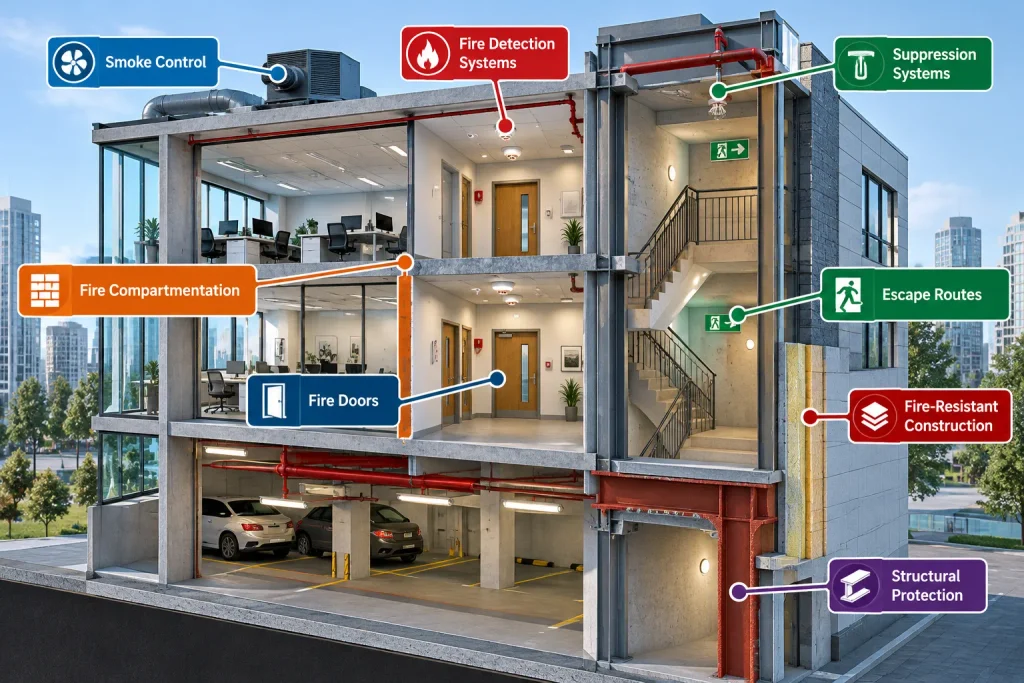
Fire engineering can therefore be particularly relevant to professionals involved with the design and technical evaluation of buildings.
ProQual Level 5 Diploma in Fire Engineering Design
ATTICS International UK offers the ProQual Level 5 Diploma in Fire Engineering Design.
The qualification focuses on:
- Fire engineering principles
- Fire safety design
- Building performance
- Design considerations
It is listed under qualification number 610/6991/7.
This specialist pathway can be relevant to professionals seeking knowledge of how fire safety considerations are incorporated into the built environment and design processes.
Passive Fire Protection Qualifications
Passive fire protection is an important component of building fire safety.
Unlike active systems that normally require activation or operation, passive fire protection is incorporated into building construction to help restrict fire and smoke spread and maintain the intended performance of building elements.
Examples can include:
- Fire doors
- Fire stopping
- Fire-resistant walls
- Fire-resistant floors
- Compartmentation
- Penetration sealing
- Fire-resistant structural protection
- Dampers and associated fire-stopping arrangements
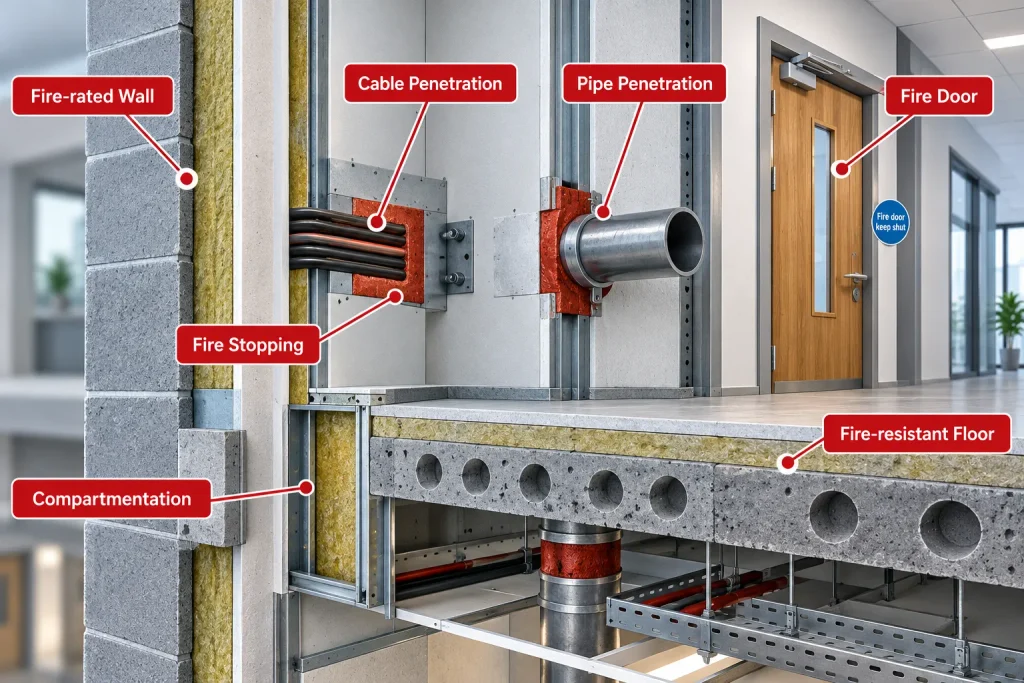
The inspection of passive fire protection therefore requires an understanding of construction, fire performance, installation quality and inspection principles.
ProQual Level 5 Diploma in Passive Fire Protection Inspection
ATTICS International UK offers the ProQual Level 5 Diploma in Passive Fire Protection Inspection.
The qualification focuses on:
- Passive fire protection
- Fire stopping
- Inspection principles
- Quality
- Compliance
The qualification number is 610/2749/2.
This specialist route can be relevant to professionals involved in building inspections, construction, facilities management, fire safety and passive fire protection.
Advanced Fire Safety Design and Building Risk Management
Modern buildings can involve complex construction methods, engineered fire safety solutions, mixed-use environments and multiple interacting risk factors.
Professionals working with complex buildings may therefore require knowledge beyond basic fire safety principles.
Advanced fire safety design can involve:
- Fire safety strategies
- Building risk management
- Performance-based design
- Complex building considerations
- Fire engineering concepts
- Risk evaluation
- Building safety interfaces
- Fire protection strategies
ProQual Level 6 Diploma in Advanced Fire Safety Design and Building Risk Management
ATTICS International UK’s Level 6 specialist qualification focuses on advanced fire safety design and building risk management.
The qualification includes areas such as:
- Advanced fire safety design
- Building risk management
- Fire safety strategies
- Performance-based design
The qualification number is 610/7451/7.
This represents the advanced end of ATTICS International UK’s specialist fire safety portfolio and is aimed at developing knowledge relevant to complex fire safety and building risk considerations.
Understanding Fire Safety Qualification Levels
Qualification levels can help learners understand the approximate depth and complexity of a qualification, but the level alone does not tell you everything about the programme.
Two qualifications at the same level can have completely different subject areas, learning outcomes and professional applications.
For example:
| Qualification area | Main focus | Potential professional application |
|---|---|---|
| Fire Safety Awareness | Basic awareness and prevention | Workplace fire safety |
| Fire Marshal / Warden | Emergency responsibilities | Workplace evacuation support |
| Fire Risk Assessment | Assessment and risk control | Fire risk assessment |
| Fire Safety Management | Organisational fire safety | Fire safety management |
| Fire Engineering | Engineering and design | Building and fire engineering |
| Passive Fire Protection | Inspection and fire stopping | Passive protection inspection |
| Advanced Fire Safety Design | Complex buildings and risk | Advanced building safety |
The level should therefore be considered alongside the subject matter, awarding organisation, assessment approach, entry requirements and intended professional application.
How Do You Choose the Right Fire Safety Qualification?
Choosing a fire safety qualification becomes easier when you start with your intended professional responsibility rather than simply searching for the highest qualification level.
Ask yourself the following questions.
1. What is your current role?
Your existing role can help determine the most relevant subject area.
For example:
- Facilities management may require fire safety management knowledge.
- Health and safety roles may benefit from fire risk assessment knowledge.
- Construction professionals may benefit from passive fire protection or fire engineering knowledge.
- Property professionals may need building fire safety and risk management knowledge.
- Fire safety professionals may require specialist risk assessment qualifications.
2. What type of work do you want to perform?
Consider whether your intended role involves:
- General fire safety
- Fire risk assessment
- Fire safety management
- Fire engineering
- Passive fire protection
- Inspection
- Building safety
- Compliance
- Consultancy
The answer can help narrow the qualification type.
3. Does the qualification match your experience?
A qualification should be appropriate to your current knowledge and professional experience.
Some programmes are introductory, while others assume previous technical knowledge or professional experience.
Always review the formal entry requirements before enrolment.
4. How is the qualification assessed?
Assessment methods can vary considerably.
Depending on the programme, assessment may involve:
- Examinations
- Open-book assessments
- Written assignments
- Practical assessments
- Case studies
- Workplace evidence
- Professional discussions
- Scenario-based assessments
For example, one major UK fire safety certificate uses an open-book examination alongside a practical fire risk assessment.
Understanding assessment requirements before enrolling can help you choose a programme that fits your learning circumstances.
5. Is it a qualification, training course or CPD programme?
This distinction is particularly important.
The Fire Industry Association explicitly distinguishes its focused Essentials training from its formal qualification routes: Essentials courses provide focused learning and do not lead to a regulated qualification, whereas its qualification programmes involve structured learning and assessment leading to recognised regulated qualifications.
Always check what certificate or qualification you will actually receive after completion.
Are Fire Safety Qualifications Regulated in the UK?
Some UK fire safety qualifications are regulated, while others are professional certificates, training programmes or CPD courses.
These should not automatically be treated as equivalent.
For example, the Institution of Fire Engineers states that its qualifications are recognised and regulated by Ofqual and include multiple levels and specialist subject areas.
The appropriate question is therefore not simply:
“Is this a fire safety certificate?”
Instead, consider:
- Who awards it?
- Is it regulated?
- What level is it?
- What are the learning outcomes?
- How is it assessed?
- What professional role is it designed to support?
- What experience is expected?
- Does it fit your intended scope of work?
These questions provide a much clearer basis for comparing qualifications.
Fire Safety Qualifications and UK Legislation
A qualification does not replace an organisation’s legal responsibilities.
This is an important point for employers, managers and professionals.
Under the Fire Safety Order framework in England and Wales, responsibility remains with the Responsible Person and other relevant duty holders. Government guidance states that the Responsible Person must carry out and regularly review fire risk assessments and maintain appropriate fire safety measures.
Professional training can support competence, but organisations must still establish appropriate arrangements for managing fire safety.
The Fire Safety Act 2021 also clarified the relevance of building structure, external walls and flat entrance doors in certain multi-occupied residential buildings.
Furthermore, section 156 of the Building Safety Act 2022 introduced additional fire safety responsibilities, including requirements relating to recording and sharing fire safety information and cooperation between responsible persons.
For professionals, this means that knowledge of current legislation and guidance should be treated as an ongoing professional responsibility.
Fire Safety Qualifications for Different Professional Roles
Different roles may require different combinations of knowledge and experience.
Fire Risk Assessor
Relevant subject areas may include:
- Fire risk assessment
- Fire safety legislation
- Building fire safety
- Fire protection
- Risk evaluation
- Professional reporting
Fire Safety Manager
Relevant subject areas may include:
- Fire safety management
- Risk management
- Emergency planning
- Compliance
- Inspection
- Organisational fire safety
Facilities Manager
Relevant areas may include:
- Fire safety management
- Risk assessment
- Emergency procedures
- Building safety
- Maintenance and inspection
Construction Professional
Relevant specialist areas may include:
- Fire engineering
- Passive fire protection
- Fire stopping
- Building fire safety
- Fire safety design
Passive Fire Protection Inspector
Relevant areas may include:
- Fire stopping
- Compartmentation
- Passive fire protection
- Inspection principles
- Quality assurance
Building Safety Professional
Relevant areas may include:
- Building risk management
- Fire safety design
- Fire engineering
- Passive protection
- Regulatory requirements
- Risk management
ATTICS International UK Fire Safety Qualifications
ATTICS International UK provides a specialist portfolio of ProQual fire safety qualifications covering several areas of professional fire safety practice.
The portfolio currently includes five specialist qualifications.
ProQual Level 5 Diploma in Fire Risk Assessment
A specialist qualification focused on fire risk assessment, building safety, compliance, health and safety, fire hazards and risk control.
ProQual Level 5 Diploma in Fire Engineering Design
A specialist qualification covering fire engineering principles, fire safety design, building performance and design considerations.
ProQual Level 5 Diploma in Passive Fire Protection Inspection
A specialist qualification focused on passive fire protection, fire stopping, inspection principles, quality and compliance.
ProQual Level 5 Diploma in Fire Safety and Risk Management
A broader professional qualification covering fire safety management, risk management, fire hazards and professional practice.
ProQual Level 6 Diploma in Advanced Fire Safety Design and Building Risk Management
An advanced qualification focused on advanced fire safety design, building risk management, fire safety strategies and performance-based design.
Together, these qualifications provide several specialist directions rather than forcing every professional into the same fire safety pathway.
Which Fire Safety Qualification Should You Choose?
There is no single fire safety qualification that is appropriate for every person.
A better approach is to match the qualification with your professional objective.
| Your professional objective | Relevant area to explore |
|---|---|
| Understand workplace fire safety | Fire safety awareness |
| Support emergency evacuation | Fire marshal / fire warden training |
| Develop fire risk assessment knowledge | Fire risk assessment |
| Manage organisational fire safety | Fire safety and risk management |
| Work with fire safety design | Fire engineering design |
| Inspect passive protection | Passive fire protection inspection |
| Work with complex building risks | Advanced fire safety design and building risk management |
This approach helps avoid selecting a qualification simply because it has a particular level or attractive course title.
What Should You Check Before Enrolling?
Before choosing a fire safety qualification, check the following:
Awarding organisation
Find out who awards the qualification and whether it is regulated or otherwise formally recognised.
Qualification level
Understand the qualification level and what that level means within the relevant framework.
Course content
Review the syllabus rather than relying only on the course title.
Assessment method
Check whether the qualification uses examinations, assignments, practical assessment, workplace evidence or another method.
Entry requirements
Make sure your previous education, experience and knowledge meet the stated requirements.
Learning format
Consider whether the programme is online, classroom-based, blended or distance learning.
Professional relevance
Ask whether the subject matter relates directly to your intended role.
Scope of competence
Do not assume that holding a qualification automatically makes you competent to undertake every type of fire safety activity. Your knowledge, experience and professional scope should be considered together.
Fire Safety Qualifications and Continuous Professional Development
Fire safety is not a static field.
Legislation, standards, building technology, fire protection systems, construction methods and professional expectations can change over time.
For this reason, professionals should treat qualification achievement as part of an ongoing professional development process rather than the end of learning.
Continuous development can include:
- CPD courses
- Technical updates
- Specialist training
- Industry seminars
- Professional membership
- Standards and guidance reviews
- Practical workplace experience
- Additional specialist qualifications
Professional organisations such as the FIA and IFE provide a range of training, qualification and professional development opportunities across different areas of the fire sector.
Fire Safety Qualification Pathway: A Practical Example
A professional development pathway could look like this:
Fire Safety Awareness
↓
Fire Marshal / Fire Warden Responsibilities
↓
Fire Safety or Fire Risk Assessment Knowledge
↓
Specialist Fire Safety Qualification
↓
Practical Workplace Experience
↓
Advanced Specialist Knowledge
↓
Professional Development and Continuing Competence
However, this should not be interpreted as a mandatory sequence.
A construction professional may move directly towards passive fire protection or fire engineering, while a facilities professional may focus on fire safety management and risk assessment.
The appropriate pathway depends on professional responsibilities and previous experience.
Why Specialist Fire Safety Knowledge Matters
Fire safety is a multidisciplinary field.
A fire risk assessor may need to understand building construction and human behaviour. A passive fire protection inspector may need knowledge of compartmentation and fire-stopping systems. A fire engineer may need engineering and design knowledge. A fire safety manager may need organisational risk management skills.
This is why modern fire safety education increasingly includes specialist pathways.
ATTICS International UK’s portfolio reflects this broader approach by covering fire risk assessment, fire engineering design, passive fire protection inspection, fire safety and risk management, and advanced fire safety design and building risk management.
Conclusion
Fire safety qualifications in the UK cover a broad range of professional disciplines, from basic workplace awareness through to specialist fire risk assessment, passive fire protection, fire engineering and advanced building risk management.
The right qualification depends on what you want to do rather than simply choosing the highest available level.
Professionals considering a fire safety qualification should look carefully at the awarding organisation, qualification level, syllabus, assessment method, entry requirements and intended professional application.
Whether your professional focus is risk assessment, building safety, construction, fire engineering, passive protection, facilities management or organisational compliance, selecting a qualification that aligns with your responsibilities can provide a structured foundation for developing specialist fire safety knowledge and professional capability.